Professional baseball stadium at night with dramatic lighting and betting odds displays

2026 Baseball Sportsbook Directory & Odds Comparison

Updated October 2026
Licensed
usAvailable in US
Fast payouts
18+ Only

Baseball isn't like other sports when it comes to betting. Football has its spreads, basketball lives and dies by the total, but baseball? Baseball is its own beast entirely. Over 162 games, the best teams lose 60 times, the worst teams win 60 times, and everything in between is basically organized chaos wrapped in America's pastime.

That's what makes it both frustrating and fascinating for bettors. You can do everything right analyze the starting pitchers, check the weather, study the matchups and still watch a random reliever blow a save in the ninth inning. But here's the thing: that same unpredictability creates opportunities that simply don't exist in other sports. While everyone's focused on football point spreads, baseball bettors who actually know what they're doing can quietly print money over a long season.

This guide isn't going to promise you'll become a millionaire betting on baseball. Anyone who makes that promise is selling you something. What I can promise is this: by the time you finish reading, you'll understand how baseball betting actually works, not the sanitized version the sportsbooks want you to believe. You'll learn why betting heavy favorites is usually a terrible idea, why the first five innings might be your best friend, and how a random Wednesday game in July can offer more value than a playoff matchup.

We're covering everything from the absolute basics how to read a moneyline to advanced strategies that sharp bettors use to gain an edge. Whether you're placing your first baseball bet or you've been doing this for years and want to sharpen your approach, there's something here for you. The goal is simple: help you make smarter bets, manage your bankroll better, and actually enjoy the process instead of watching your account slowly bleed out.

Fair warning: this is a long read. But baseball betting isn't a topic you can cover in 500 words and a listicle. If you want the real knowledge, you need to put in the time. Think of this as your baseball betting education, compressed into one comprehensive guide. Bookmark it, reference it throughout the season, and come back when you need a refresher.

How Baseball Betting Works

The first thing you need to understand about baseball betting is that it's fundamentally different from betting on football or basketball. Those sports are dominated by point spreads you're betting on whether a team covers a certain margin. Baseball rarely works that way. Sure, run lines exist, but they're secondary to the main event: the moneyline.

A moneyline bet is brutally simple. Pick which team wins. That's it. No spreads to cover, no margins of victory to worry about. Yankees versus Red Sox? You're choosing which team walks off the field with a W. The complexity comes from how the odds work, because unlike picking a winner in, say, March Madness where you just need to be right, baseball makes you risk different amounts based on who's favored.

American odds are displayed with plus and minus signs, and if you're new to this, it can look like hieroglyphics. But the logic is straightforward once you break it down. Negative numbers show favorites these are teams expected to win. If the Dodgers are listed at minus-180, you need to risk one hundred and eighty dollars to win one hundred dollars. Positive numbers indicate underdogs, the teams expected to lose. If the Diamondbacks are plus-155, a hundred-dollar bet wins you one hundred fifty-five dollars if they pull the upset.

Here's where it gets interesting, though. Baseball odds aren't set in stone the way point spreads are in other sports. A big reason? Pitching. The starting pitcher has an enormous impact on a baseball game's outcome far more than any single player in football or basketball affects their game. Because of this, sportsbooks have to account for pitching matchups when setting lines, and bettors have options for how they want their bets handled if there's a pitching change.

You'll see three options when placing a bet: action, one specified pitcher, or both specified pitchers. An action bet means your wager stands regardless of who pitches. The Yankees could switch from their ace to a guy they called up from Triple-A yesterday, and your bet is still live though the odds might adjust. Specifying a pitcher means if that guy doesn't start, your bet gets refunded. Most serious bettors specify pitchers because the edge they identified might disappear entirely with a pitching change.

This brings us to a concept that trips up a lot of newcomers: baseball has more variance than almost any other sport you can bet on. In the NFL, the best teams win around seventy percent of their games. In MLB? The best teams win about sixty percent, and the worst teams still win forty percent. That twenty-game gap between the best and worst baseball teams means upsets happen constantly. The Rays can beat the Yankees six times in a season. The Pirates can take a series from the Dodgers. This isn't a bug in the system it's the fundamental nature of baseball.

Why does this matter for betting? Because it means favorites lose more often in baseball than in any other major sport. That minus-200 favorite everyone's hammering? They're going to lose roughly thirty-five to forty percent of the time. And when they do lose, you're out two hundred dollars to win one hundred. The math starts looking ugly real quick when you actually run the numbers over a full season.

The other unique aspect of baseball betting is the sheer volume of games. Football gives you sixteen regular season games per team. Basketball gives you eighty-two. Baseball gives you one hundred sixty-two, and every single one of those games has betting markets. That volume is both an opportunity and a trap. Opportunity because you can be selective, waiting for spots where you genuinely have an edge rather than forcing bets. Trap because the daily grind of baseball can make you feel like you need to have action on something, anything, just to stay engaged.

Sportsbooks know this. They know that on a random Tuesday in June, people will bet the Yankees or Red Sox just because they're familiar names, even when there's no actual value in the line. Books also know that recreational bettors love betting favorites because it feels safer. Risking more to win less somehow seems smarter than betting an underdog, even though the math says otherwise.

Understanding how baseball betting works means understanding this psychological game as much as the mechanical one. The books aren't trying to predict the exact outcome of every game. They're trying to balance their exposure by getting money on both sides. When public money hammers one side too hard, lines move. Learning to read those line movements, understanding when sharp money is hitting a side versus when it's just public enthusiasm, becomes crucial to long-term success.

Live · Free tool

Baseball Live Simulator

Enter the current score, innings, outs, and starting pitcher ERA. The model projects the final score, moneyline, run line, and over/under probabilities with fair odds.

vs
5
1
Starting pitcher ERA4.00
Lower ERA = better pitching, lower scoring. Adjust based on today's starter.
Projected final score
—
—
Likely range —
Home projected
—
final runs
Away projected
—
final runs
Total projected
—
combined runs
Innings left
—
of 9 total

The model simulates the remaining innings using a negative binomial distribution based on the starting pitcher's ERA and the current state of the game. Runs are more likely in later innings, and the home team has a slight advantage.

Moneyline (winner)

Run Line (±1.5)

Total (Over/Under)

Run milestones

All markets show fair odds with no bookmaker margin. Compare these with your sportsbook to find value. The run line is baseball's version of the point spread — most games are priced around ±1.5 runs.

For informational purposes only — statistical model with no guarantee. Gambling can be addictive. Play responsibly. 18+.

Every Way to Bet on Baseball (With Real Examples)

Baseball offers more betting variety than most people realize. While the moneyline gets most of the attention, limiting yourself to picking winners leaves massive value on the table. Let's break down every major bet type you'll encounter and when each one makes sense.

Moneyline Betting

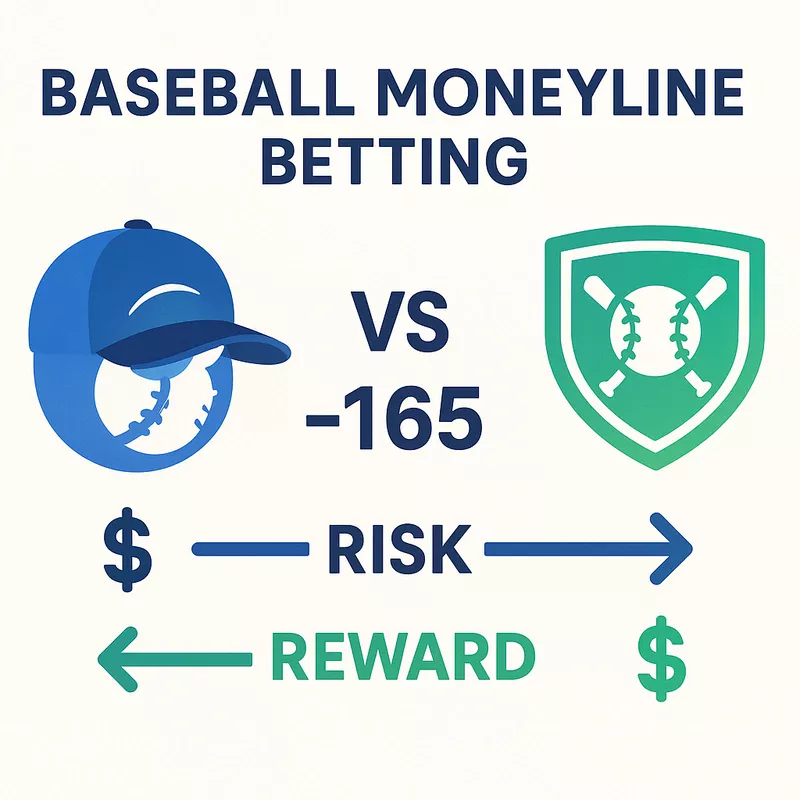
Visual diagram showing moneyline betting concept with odds and risk vs reward

The moneyline is where most bettors start, and honestly, it's where many should stay until they truly understand the other options. The concept couldn't be simpler: pick the winner. But execution is where things get complicated.

Let's say the Yankees are hosting the Orioles. The board shows Yankees minus-165, Orioles plus-145. You're confident the Yankees win this one, so you bet them. To win one hundred dollars, you need to risk one hundred sixty-five. They win five to three, you collect your hundred bucks, and everyone's happy. Straightforward enough.

But here's what separates smart moneyline bettors from the rest: they understand implied probability. Those minus-165 odds suggest the Yankees should win this game about sixty-two percent of the time. If you genuinely believe the Yankees win this matchup seventy percent of the time, you've found value. If you think they win fifty-five percent of the time, you're making a bad bet even if they happen to win today.

Most recreational bettors never do this math. They bet favorites because favorites usually win, without considering whether the price makes sense. That's how sportsbooks make money.

The moneyline sweet spot for favorites tends to live between minus-130 and minus-150. Anything beyond minus-180 starts becoming questionable value unless you have a genuinely elite matchup. And those plus-money underdogs between plus-120 and plus-160? That's often where the real value hides, especially in baseball where parity reigns supreme.

For a deeper dive into moneyline strategy, including when to bet favorites versus underdogs and how to calculate expected value, check out our complete guide to baseball moneyline betting.

Run Line Betting

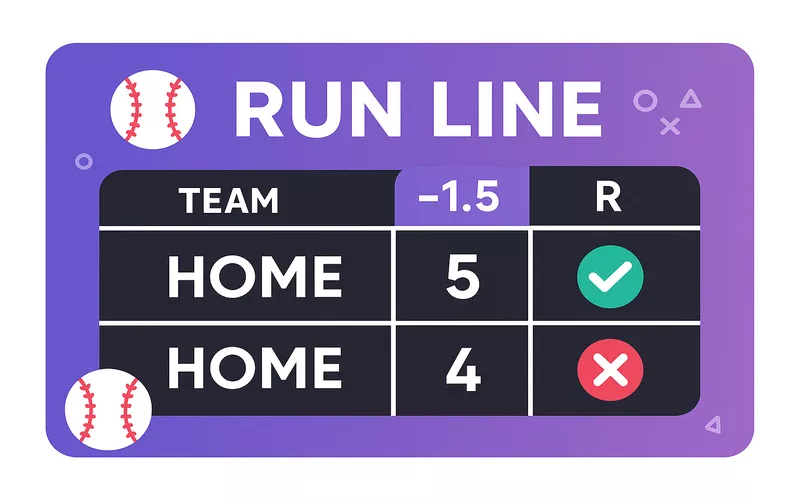
Baseball run line strategy diagram showing 1.5 run spread scenarios

The run line is baseball's version of a point spread, but with a twist: it's almost always set at 1.5 runs. The favorite has to win by two or more runs, while the underdog can lose by one run and you still cash your bet. Alternative run lines exist sometimes you'll see 2.5 or even 0.5 but 1.5 is the standard.

Going back to our Yankees-Orioles example, the run line might look like Yankees minus-1.5 at plus-115, Orioles plus-1.5 at minus-135. Notice how the odds flipped compared to the moneyline. The Yankees are still favored, but now you're getting plus money because winning by two runs is significantly harder than just winning.

Here's the crucial question: when should you take the run line instead of the moneyline? The answer usually involves heavy favorites. If a team is minus-220 on the moneyline, taking them minus-1.5 at plus-140 can make more sense. You're betting they don't just win, but win decisively which elite teams with strong starting pitchers often do.

The flip side works for underdogs. That plus-145 Orioles moneyline becomes minus-135 on the plus-1.5 run line. You're paying juice, but you get a safety net. They can lose by one run and you still win. In a close game where you're not confident the underdog wins outright but think it'll be tight, the run line offers insurance.

The catch? Roughly thirty percent of MLB games are decided by exactly one run. That means the run line creates a lot of bad beats. Your team wins but doesn't cover, or they keep it close but lose by that killer two-run margin. Understanding run line strategy means knowing when that extra cushion or better payout is worth the risk.

We've got an entire breakdown of run line strategy, including home versus road considerations and when to use alternative lines, in our complete run line guide.

Totals (Over/Under)

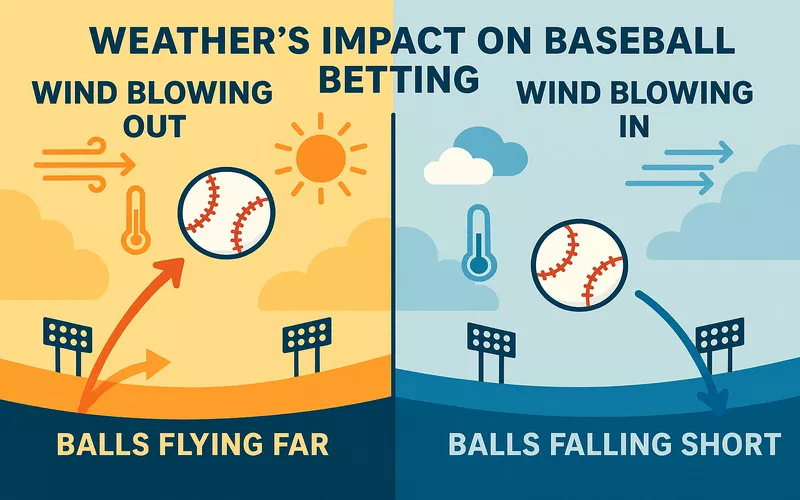
Illustration showing weather's impact on baseball betting with wind and temperature effects

Betting totals means you're wagering on the combined runs scored by both teams. The sportsbook sets a number say, 8.5 runs and you bet whether the final score goes over or under that total.

What makes baseball totals unique is how many factors influence them. The starting pitchers are obviously huge. Two aces facing off? That total might be set at 7.5, and the smart money often pounds the under. Two struggling fifth starters on a hot day in a hitter-friendly park? The total might be 10.5, and it still might not be high enough.

Ballpark matters enormously for totals. Coors Field in Colorado, sitting at altitude where the thin air helps balls fly, regularly sees totals of 11.5 or 12. Oracle Park in San Francisco, with its deep dimensions and cold bay winds, might see totals of 7. The same two teams playing in different parks could have totals that differ by three runs.

Weather is the other critical factor. Wind blowing out to the outfield turns routine fly balls into home runs. Ten mile per hour winds blowing out can add two or three runs to a game's total. Wind blowing in keeps balls in the park and favors pitchers. Check the forecast, check the wind speed, check the direction relative to the ballpark's orientation.

Temperature affects ball flight. Warm temperatures help the ball travel. Cold weather anything below fifty-five degrees kills offense. The ball doesn't carry, hitters can't grip properly, and pitchers have better command. Humidity affects movement on pitches. Checking the weather report before betting a total isn't being thorough it's being responsible.

First Five Innings (F5) Betting

This is where we get into sharper territory. First five innings betting, often called F5, means you're only wagering on the score after five complete innings. Why would anyone want that limitation?

Control. Betting the full game means you're exposed to bullpens, late-game situations, extra innings, and all sorts of randomness. Betting F5 means you're mostly betting on the starting pitchers, and starting pitchers are far more predictable than bullpens. If you've done your homework on the starting matchup and feel confident about how it plays out, F5 lets you isolate that edge while eliminating a ton of variance.

The best part? F5 bets can end in a push. If the game is tied after five innings, you get your money back. This safety valve doesn't exist in regular moneyline betting, where you're either right or wrong.

Sharp bettors love F5 for over bets too. If you want to bet the over and you're worried about elite relievers shutting the game down late, bet the F5 over instead. You get five innings of offense, and if both starting pitchers are struggling, you cash early without sweating the bullpen lockdown in innings seven through nine.

There's an entire strategic universe around F5 betting that we've covered in our comprehensive first five innings guide, including which starting pitcher metrics matter most and when full-game bets make more sense.

Prop Bets

Player props have exploded in popularity, and for good reason they let you target specific matchups and situations rather than trying to predict the entire game's outcome.

Hitter props cover everything from total bases and hits to home runs and RBIs. If you know the Phillies' slugger crushes left-handed pitching and tonight's starter is a lefty who gives up fly balls, a home run prop might offer value that doesn't exist in the team's moneyline odds.

Pitcher props focus on strikeouts, hits allowed, earned runs, and outs recorded. The strikeout prop is particularly popular. If a pitcher averages eight strikeouts per game and tonight he's facing a team that strikes out twenty-seven percent of the time, the over on his strikeout total might be easy money.

The newer phenomenon is the same game parlay, or SGP. This lets you combine multiple props from one game into a single bet with longer odds. Hit a three-leg SGP and turn ten dollars into one hundred. The catch is all three legs have to hit, and sportsbooks are smart about pricing these so they maintain their edge.

Game props offer action on things like "first team to score" or "will there be a grand slam" or the increasingly popular NRFI no run first inning. NRFI betting has become its own science, with bettors analyzing top-of-the-order matchups and pitcher first-inning statistics to find edges.

Our prop betting guide breaks down every angle, from researching matchup history to identifying which props offer the best value and which ones are trap bets designed to separate you from your money.

Parlays and Series Betting

Parlays are the siren song of sports betting. Link multiple bets together, and if they all hit, the payout multiplies beautifully. A three-team parlay at standard odds might pay six to one. Make it a four-teamer and you're looking at ten to one or better.

The problem is simple math. You need every leg to hit. A three-team parlay where each leg has a fifty percent chance of winning? You've only got a twelve-and-a-half percent chance of cashing. Sportsbooks love parlays because they love the action, but long-term winning bettors tend to avoid them.

Series betting offers a middle ground. Instead of betting individual games, you bet the series outcome. Yankees versus Red Sox, three-game series, you bet Yankees to win the series. They just need to win two of three. This smooths out some variance while still offering plus-money odds.

Futures betting like picking the World Series winner or division champions is available year-round. These tie up your money for months and the vig is brutal, but hitting a fifty-to-one future turns a hundred-dollar bet into five grand. Just understand that's where the longshot value lives, not in the favorites.

Live Betting

Live betting wagering on games in progress has revolutionized how people bet baseball. The odds update constantly based on the score, inning, runners on base, and who's coming up to bat.

The beauty of live betting is you can watch the game and react to what's actually happening rather than predicting what might happen. Starting pitcher looks terrible through two innings? The odds might shift dramatically in your favor if you want the underdog. Opposite team's ace cruising? Maybe you grab the F5 under at better odds than you would've gotten pre-game.

The downside is that sportsbooks are fast. Really fast. By the time you see an opportunity, the line has probably already moved. And the temptation to chase losses by jumping into live bets without proper analysis is real. Live betting requires discipline more discipline, honestly, than most bettors possess.

Winning Strategies for Baseball Betting

Strategy separates winning bettors from everyone else. You can understand every bet type that exists, but without a systematic approach to finding value and managing your money, you're just gambling with extra steps. Let's talk about what actually works.

The Fundamentals of Profitable Baseball Betting

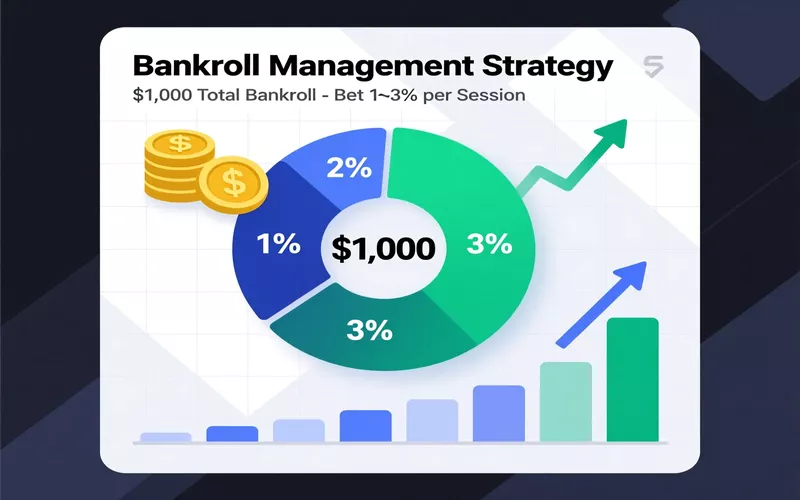
Bankroll management chart showing 1-3% betting unit strategy

Bankroll management isn't sexy. It doesn't involve analyzing obscure stats or finding hidden angles. But it's the difference between lasting a full season and busting out by June.

The standard rule: never bet more than one to three percent of your bankroll on a single game. If you've got a thousand dollars set aside for baseball betting, that means ten to thirty dollars per bet. Sounds boring, right? Good. Boring keeps you alive.

Here's why this matters. Even great bettors lose forty to forty-five percent of their bets. Baseball's variance means losing streaks happen. If you're betting five or ten percent of your bankroll per game, a normal cold streak wipes you out. At one to three percent, you can weather a dozen losses in a row without destroying your account.

The flat betting approach same amount on every bet regardless of confidence level is the most sustainable. You might think you can identify which bets are "locks" and deserve bigger stakes, but you can't. Nobody can. The games you're most confident about will burn you just as often as the ones you're unsure about. Flat betting removes the emotional element and forces discipline.

Line shopping is the other non-negotiable fundamental. Having accounts at multiple sportsbooks and comparing lines before every bet adds up enormously over time. Finding minus-140 instead of minus-145 on a favorite, or plus-155 instead of plus-150 on an underdog these differences seem tiny on one bet. Over a hundred bets, you're talking about hundreds or thousands of dollars.

Think of it this way: if you can consistently get five cents of better value on every bet, you're essentially getting a free bet every twenty wagers. Most bettors ignore this because checking three different apps feels like work. That's exactly why sharp bettors do it religiously.

Pitching Analysis: The Foundation of Baseball Betting

You cannot consistently win betting baseball without understanding starting pitching. Period. The starting pitcher determines the first five to six innings of the game, and in many games, that's enough to decide the outcome before bullpens even get involved.

Basic stats like ERA earned run average tell you something, but they're heavily influenced by defense and luck. A pitcher with a 3.50 ERA might actually be worse than a guy with a 4.00 ERA if you dig deeper. That's where advanced metrics become critical.

FIP, which stands for fielding independent pitching, strips out everything the defense controls and focuses purely on strikeouts, walks, and home runs. If a pitcher has a 3.20 ERA but a 4.10 FIP, that's a warning sign. He's probably been lucky and due for regression. The opposite scenario high ERA, low FIP suggests a pitcher who's been unlucky and might be undervalued.

WHIP, which measures walks and hits per inning pitched, tells you how many baserunners a pitcher allows. A pitcher with a WHIP under 1.10 is elite. Above 1.40, he's probably getting shelled. The strikeout-to-walk ratio matters too. You want pitchers who miss bats and don't issue free passes.

Recent form trumps season-long stats. A pitcher might have great numbers overall but be clearly declining over his last four starts. Velocity drops, diminishing strikeout rates, increasing hard contact these signs show up in the data before they show up in his ERA.

Platoon splits how pitchers perform against left-handed versus right-handed batters create huge edges. Some pitchers dominate same-handed hitters but get destroyed by opposite-handed bats. If tonight's lineup is stacked with six lefties and the opposing pitcher has a 5.20 ERA against lefties, that's actionable information.

The matchup history between a pitcher and the opposing team's lineup matters, but with context. A pitcher might have great numbers against a team, but if that was three years ago with a different repertoire, it's meaningless. Recent matchups with the current roster are far more relevant.

The Underdog Advantage in Baseball

Baseball has more parity than any other major sport, which creates a structural advantage for underdog bettors. The math is simple but powerful.

Favorites priced beyond minus-150 or minus-160 need to win sixty percent or more of their games just to break even. Looking at historical data, even elite teams don't maintain sixty-plus percent win rates except in special seasons. The 2001 Mariners won one hundred sixteen games and still lost forty-six times. They were the best team in decades, and they still failed to cover the run line or moneyline in those forty-six losses.

Meanwhile, underdogs priced at plus-140 only need to win about forty-two percent of the time to be profitable. That's a massive cushion. You can be wrong more often than you're right and still make money. This is why sharp bettors gravitate toward underdogs while recreational bettors pound favorites.

The sweet spot for underdog betting seems to live between plus-120 and plus-160. These are teams that have a legitimate chance to win but aren't total longshots. You're not betting bottom-feeders against aces. You're finding spots where the public overvalues the favorite and creates value on the other side.

Divisional underdogs deserve special attention. Teams play their division rivals nineteen times per season. They know each other. The talent gap shrinks through familiarity. A team that's ten games under five hundred can still take a series from a division leader because they've seen that pitching staff a dozen times already this year.

Situational Factors That Create Edges

Baseball is a daily grind, and the schedule creates exploitable situations that don't exist in football or basketball's weekly formats.

Travel and rest days matter more than most bettors realize. A team that played on the East Coast last night, flew to the West Coast overnight, and has a day game today? That's a tired team. The stats back this up teams in this situation perform measurably worse. The line might not fully account for it because it's not obvious, which is where your edge lives.

Day games after night games especially getaway day games before a road trip tend to favor underdogs. The favorite might be looking ahead, resting regulars, or just flat after late-night travel. These spots won't jump off the screen, but over a season they add up.

Series positioning creates patterns too. Teams rarely get swept. After losing the first two games of a three-game series, a team facing elimination in game three often shows up more motivated. The line might not reflect this urgency, especially if they're already underdogs. Game one of a series tends to favor favorites as teams play their best lineups fresh off rest.

External Factors: Weather and Ballparks

Weather impacts baseball more than any other mainstream sport. Wind, temperature, and humidity don't just matter they can completely flip whether you should bet over or under.

Wind speed and direction is the big one. Wind blowing out to the outfield turns routine fly balls into home runs. Ten mile per hour winds blowing out can add two or three runs to a game's total. Wind blowing in keeps balls in the park and favors pitchers. Check the forecast, check the wind speed, check the direction relative to the ballpark's orientation.

Temperature affects ball flight. Warm temperatures help the ball travel. Cold weather anything below fifty-five degrees kills offense. The ball doesn't carry, hitters can't grip properly, and pitchers have better command. Humidity affects movement on pitches. Checking the weather report before betting a total isn't being thorough it's being responsible.

Ballpark factors vary wildly. Coors Field in Colorado is a launching pad where totals regularly hit twelve or thirteen runs. Oracle Park in San Francisco suppresses offense dramatically with its dimensions and cold wind off the bay. Yankee Stadium's short right field porch helps lefty power hitters. Fenway Park's Green Monster creates unique dynamics for both hitters and pitchers.

Understanding these factors means you're seeing things the average bettor misses. They look at the starting pitchers and make a bet. You look at the starting pitchers, see wind blowing out at twelve miles per hour, recognize the game's in a hitter-friendly park, and bet the over while everyone else is fixated on the pitching matchup.

Line Movement and Market Intelligence

Professional bettors don't just find value they understand how betting markets work and how to read the signals embedded in line movement.

When a line opens and moves, there's usually a reason. If the Yankees open at minus-150 and move to minus-165 within an hour, that's sharp money hitting the Yankees hard. If the Yankees stay at minus-150 despite seventy percent of public tickets being on them, that's sportsbooks holding the line because sharp money is on the Orioles.

This is called reverse line movement, and it's one of the clearest signals of where smart money sits. The public loves favorites and popular teams. When a line moves away from the public side, it means sportsbooks respect the money coming in on the other side more than the volume of tickets on the popular side.

Steam moves when lines move sharply across multiple sportsbooks simultaneously indicate a large, respected bet hitting the market. These moves happen in seconds, and by the time you see them, the line's already moved. But understanding that they exist helps you avoid betting into bad numbers.

The timing of your bet matters. Betting Sunday night or Monday morning when lines first open can get you numbers before sharp bettors move them. Betting an hour before first pitch means you're getting the sharpest number after all the information and money has been processed. Neither approach is inherently better it depends on your edge and what information you have access to.

The Biggest Baseball Betting Mistakes (And How to Avoid Them)

Knowing what not to do matters as much as knowing what to do. Most bettors lose not because they lack information, but because they repeat the same mistakes over and over.

The number one mistake? Betting heavy favorites blindly. That minus-220 Yankees moneyline looks safe until you realize you need to win seventy percent of those bets just to break even. The Yankees aren't winning seventy percent against anyone. Even elite teams lose one out of three games minimum. You're essentially paying premium prices for mediocre probability.

Ignoring starting pitcher matchups is the second killer. Betting teams based on their overall record without considering tonight's specific pitching matchup is like betting blind. A team with a great record might be starting their fifth starter against another team's ace. That context completely changes the game's outlook, but casual bettors miss it because they're fixated on the team's win-loss record.

Overlooking bullpen quality creates constant disappointment. Your starting pitcher dominates through six innings, your team leads by two runs, and then the bullpen implodes in the eighth. This happens so often in baseball that sharp bettors either bet the first five innings to avoid it entirely or specifically research bullpen stats before betting full games.

Chasing losses during baseball's long season destroys bankrolls. You lose three bets in a row, panic sets in, and suddenly you're doubling your bet size to "get even quick." This is how you go from a controlled loss to a catastrophic one. Baseball plays every day for six months. There's no urgency to recover today's losses today. Discipline means sticking to your unit size no matter what.

Betting with your heart instead of your head ruins otherwise smart bettors. Everyone has a favorite team, but betting on them every game regardless of matchup or value is financial suicide. Your fandom clouds your judgment. You see what you want to see instead of what's actually there. If you can't bet against your favorite team when the spot's right, don't bet their games at all.

Neglecting advanced statistics in favor of basic numbers is leaving money on the table. Batting average and ERA are fine for casual fans, but serious bettors need FIP, WHIP, wOBA, and park-adjusted numbers. These advanced metrics predict future performance better than traditional stats, which makes them invaluable for finding value before the market catches up.

Poor bankroll management shows up in multiple forms: betting too much per game, not tracking results, failing to adjust bet sizing as your bankroll changes. If you're up thirty percent on the season but still betting the same dollar amount you started with, you're not properly scaling. If you're down forty percent and still firing the same bet size, you're accelerating toward zero.

Not shopping lines is pure laziness that costs real money. Using one sportsbook because it's convenient means you're consistently getting worse numbers than bettors who check three or four books before placing each bet. Those five or ten cents add up to hundreds of dollars over a season. The effort takes sixty seconds per bet. The return is literally free money.

Taking Your Baseball Betting to the Next Level

Once you've mastered the basics and avoided common mistakes, the next level involves deeper analytical approaches and understanding market dynamics that casual bettors never consider.

Top-down versus bottom-up handicapping represents two fundamentally different approaches. Bottom-up handicapping starts with the game itself analyzing the starting pitchers, lineups, matchups, and conditions to form your own opinion of what should happen. Top-down handicapping starts with the market watching how lines move, identifying where sharp money lands, and following the "smart money" rather than doing your own analysis.

Neither approach is objectively better. Bottom-up gives you independent opinions and potentially lets you spot value before the market does. Top-down lets you piggyback on professional bettors' research without doing all the work yourself. Most successful bettors use a hybrid approach, forming their own opinions but respecting what market movements tell them about where the smart money sits.

Building statistical models takes handicapping to another level entirely. Instead of manually analyzing each game, you create a system that processes data automatically and identifies games where your model's prediction differs significantly from the betting line. These models can account for dozens of variables simultaneously something human analysis simply can't match for consistency.

The catch is that building models requires statistical knowledge, programming ability, and constant refinement. The models that worked three years ago might not work now because the betting market adapts. But for bettors serious about treating this as a business rather than a hobby, modeling represents the frontier of sophisticated baseball betting.

Exploiting post-trade deadline adjustments creates annual opportunities. The trade deadline happens at the end of July, and rosters undergo significant changes. Teams either go all-in for playoff pushes or sell off talent to rebuild. The betting markets take time to adjust to these new realities. A team that adds an ace starter and a productive bat is suddenly stronger than their odds suggest. A team that traded away three regulars is weaker than the lines initially reflect.

September call-ups similarly create temporary market inefficiencies. When teams expand their rosters in September, you'll see younger players getting at-bats and innings who weren't there in August. The betting lines might not fully account for how this changes team dynamics until a week or two into September.

Peer-to-peer betting exchanges offer an alternative to traditional sportsbooks. Instead of betting against the house, you're betting against other individuals who are willing to take the opposite side. This often results in better odds because there's no built-in sportsbook edge. The catch is lower liquidity you might not always find someone willing to take your bet at your preferred odds.

Essential Tools for Baseball Bettors

The right tools make research faster and more effective. You don't need every resource that exists, but a few key tools dramatically improve your betting process.

Odds comparison sites let you instantly see which sportsbooks offer the best lines for any game. Instead of manually checking five different apps, these aggregators show everything in one place. The time saved compounds over a season, and the better lines you find translate directly to profit. Sites like OddsChecker and TheLines serve this purpose well.

Advanced statistics databases give you access to metrics that matter. FanGraphs and Baseball Savant provide detailed pitching and hitting stats that go far beyond what you'll find on ESPN or team websites. Want to know a pitcher's spin rate, exit velocity against, or hard-hit percentage? These databases have it. Most data is free, though some premium features require subscriptions.

Weather resources matter more than bettors realize. Basic weather apps aren't enough you need wind speed, direction, and temperature at game time. Websites specifically designed for sports betting weather analysis take the guesswork out. This becomes especially important when betting totals, where a five degree temperature difference or wind direction shift completely changes the play.

Line movement trackers show you how betting lines have moved from opening to current, plus what percentage of public money is on each side. This information helps identify reverse line movement and sharp action. Many sportsbooks now include this data directly in their apps, though third-party tracking sites often provide more detailed historical information.

Bankroll calculators and tracking spreadsheets keep your betting organized. You need to know your win rate, return on investment, and how much you're up or down on the season. Manual tracking in a spreadsheet works fine, though dedicated apps make this easier. The tool matters less than the habit of actually tracking every bet.

FAQ

How does baseball betting work for beginners?

Baseball betting centers on moneyline bets simply picking which team wins. Odds display as plus or minus numbers. Minus numbers show favorites where you risk more to win less (minus-150 means risk one hundred fifty to win one hundred). Plus numbers show underdogs where you risk less to win more (plus-140 means risk one hundred to win one hundred forty). Unlike football or basketball spreads, most baseball betting focuses on straight-up winners, though run lines (similar to spreads) and totals (over/under on combined runs) are available options.

What is the difference between moneyline and run line in baseball?

Moneyline bets require only that your team wins the game outright. Run line bets add a 1.5-run spread favorites must win by two or more runs while underdogs can lose by one run and still cash. Run lines offer better odds on favorites (turning minus-180 moneylines into plus-money) and safer plays on underdogs (adding a one-run cushion). Roughly thirty percent of games are decided by one run, making run lines riskier but potentially more profitable when used correctly.

Can you actually make money betting on baseball?

Yes, but it requires discipline, research, and proper bankroll management. Baseball's high variance means short-term results fluctuate wildly even good bettors lose forty to forty-five percent of their bets. Long-term profitability comes from finding value consistently, betting one to three percent of your bankroll per game, and avoiding common mistakes like betting heavy favorites or chasing losses. Most bettors lose because they lack discipline, not because winning is impossible. Success takes treating it seriously rather than casually.

Conclusion

Baseball betting offers unique opportunities that don't exist in other sports. The long season creates ample chances to find value. The high variance means favorites lose often, creating underdog value. The daily grind means patient bettors can wait for genuine edges rather than forcing action.

Success comes down to fundamentals: understanding how different bet types work, analyzing starting pitchers properly, managing your bankroll conservatively, and avoiding mistakes that trap recreational bettors. You don't need to be perfect. You just need to be better than the average bettor and disciplined enough to stick to your process through inevitable losing streaks.

The strategies in this guide work, but only if you implement them consistently. Cherry-picking advice or abandoning your system after a rough week guarantees failure. Baseball rewards patience and punishes impatience.

Start small, track everything, learn from both wins and losses, and gradually build your bankroll and knowledge. For deeper dives into specific bet types and strategies, explore our cluster pages on moneyline betting, run lines, first five innings, prop betting, and advanced strategy. Each covers its topic in detail with tactics you can implement immediately.

The sportsbooks aren't unbeatable. They're just better prepared than most bettors. Level the playing field by doing the work, and baseball betting becomes not just entertaining, but potentially profitable.