
2026 First 5 Innings Betting – Pitcher Analytics & ROI
 Available in US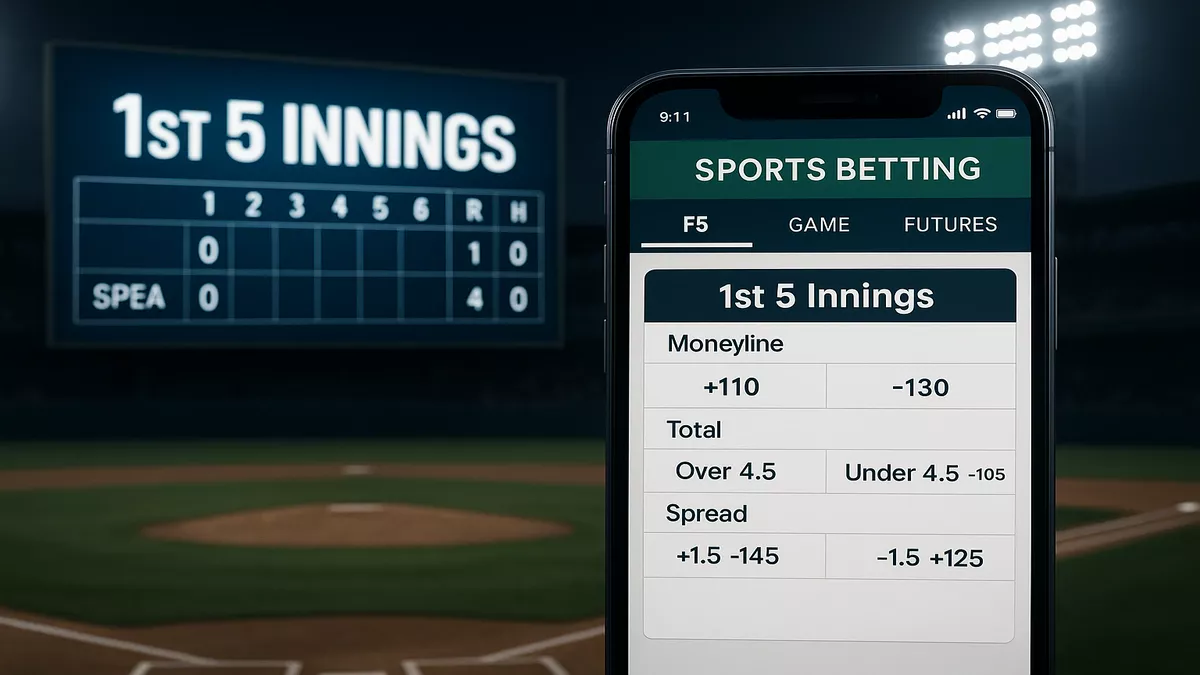
If you’ve been betting baseball for any length of time, you’ve experienced this scenario: Your starting pitcher is dealing. Six innings, one run, eight strikeouts. Your team is up 3-1 heading into the seventh. You’re already counting your winnings. Then the bullpen enters, promptly loads the bases, gives up a grand slam, and you watch a winning bet turn into a losing one in about four minutes.
Welcome to the frustrating reality of full-game baseball betting. You handicap everything perfectly—the starting pitchers, the matchups, the weather, the lineups—and then some reliever you’ve never heard of decides tonight’s the night he forgets how to throw strikes. Your analysis was right. Your bet was good. But the outcome was wrong because you exposed yourself to variables you couldn’t possibly predict.
This is exactly why first five innings betting exists. Sharp bettors figured out years ago that starting pitchers are predictable, bullpens are chaos, and betting only on the part of the game you can actually analyze makes enormous sense. F5 betting, as it’s commonly called, has quietly become the preferred method for professional baseball bettors while recreational money continues pounding full-game lines.
The concept is simple: you’re betting on the score after five complete innings. That’s it. Whatever happens in innings six through nine is completely irrelevant to your bet. If your team is winning after five, you win. If they’re losing after five, you lose. If it’s tied after five, the bet pushes and you get your money back.
This guide breaks down everything you need to know about F5 betting—why it works, how to handicap it properly, which situations offer the most value, and how to avoid the common mistakes that trap bettors who don’t understand what makes first five innings betting fundamentally different from full-game wagering.
Why Sharp Bettors Isolate the Starting Pitcher in 2026
The mechanics are straightforward, but the implications are profound. When you bet first five innings, you’re essentially betting on a shortened game. Five complete innings means the home team gets five at-bats and the away team gets five at-bats, unless the home team is already winning after the top of the fifth, in which case the bottom of the fifth doesn’t need to be played.
The betting options mirror full-game bets: moneyline, run line, and totals. A first five innings moneyline bet is picking which team will be ahead after five innings. A first five innings run line is typically minus-0.5 or plus-0.5, meaning the favorite needs to be winning after five or the underdog needs to be tied or winning. First five innings totals are betting the over or under on combined runs scored in the first five innings only.
The push element is crucial. If the game is tied after five innings, first five moneyline and run line bets push. You get your money back. This doesn’t exist in full-game betting, where ties just mean extra innings until someone wins. The push adds a safety valve that reduces variance significantly.
Here’s a real example. The Rays are playing the Red Sox. The F5 moneyline shows Rays minus-135, Red Sox plus-115. You bet the Rays. After five innings, the score is Rays 3, Red Sox 1. You win. What happens in innings six through nine is completely irrelevant. The Red Sox could come back and win 5-4 in the ninth inning and your F5 bet still wins because you were only betting on the first five.
The settlement rules matter too. For an F5 bet to have action, the game must complete five full innings, or four and a half if the home team is ahead. If a game gets postponed or rained out after three innings, F5 bets are canceled and stakes are returned. This rarely happens, but it’s worth knowing.
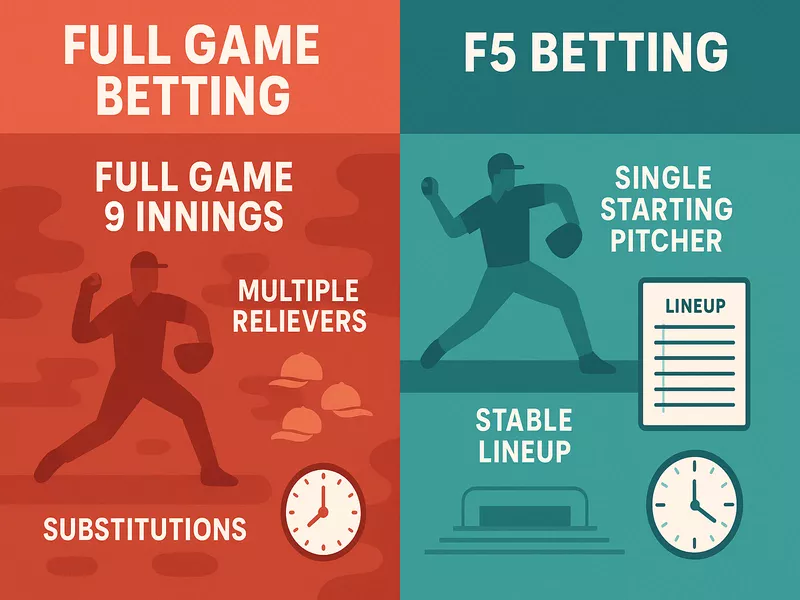
What makes F5 betting powerful is the strategic shift it creates. Full-game betting forces you to predict nine innings of baseball, including bullpen performances, late-inning defensive replacements, pinch-hitting decisions, and all sorts of managerial moves you can’t possibly forecast. F5 betting lets you focus almost entirely on the starting pitchers and the first time through the lineup, which are far more predictable.
The Strategic Advantages of F5 Betting
There are specific, measurable reasons why sharp bettors gravitate toward first five innings betting. These aren’t theoretical advantages—they’re concrete edges that show up in long-term results.
Isolating starting pitcher performance is the primary advantage. Starting pitchers are infinitely more predictable than bullpens. You can analyze a starter’s recent form, their historical performance against this opponent, their home-road splits, their effectiveness against left-handed or right-handed batters. You can look at advanced metrics like FIP and WHIP and strikeout rates and get a reasonable expectation of how they’ll perform.
Bullpens are random number generators by comparison. A reliever who’s been lights out for three weeks suddenly can’t find the strike zone. A closer who hasn’t blown a save in two months serves up a walkoff home run. Middle relievers face one batter or six batters depending on matchups and situations you can’t predict. Handicapping bullpens requires not just analyzing individual pitchers but predicting exactly which pitchers will be used in which situations.
By betting F5, you’re eliminating this uncertainty entirely. You’re betting on the predictable part of the game and ignoring the chaos.
Avoiding the extra innings rule is another huge advantage. MLB’s extra innings rule puts a runner on second base to start the tenth inning. This artificially increases scoring and creates randomness. A game that would’ve been a pitchers’ duel suddenly becomes a coin flip based on who can manufacture a run from second base first. F5 betting eliminates this factor completely.
Lineup stability in the first five innings creates predictability. The starting lineup plays. Managers don’t make defensive substitutions in the third inning. Power hitters don’t get pinch-hit for. The matchups you analyzed are the matchups that actually happen. In full-game betting, late-inning substitutions can completely change the complexion of the game. In F5 betting, what you see at first pitch is what you get.
Weather impact is minimized over five innings compared to nine. Temperature, wind, and humidity affect ball flight and pitcher performance, but these factors often intensify or change as games progress into night. A day game starting at 1pm might be seventy-five degrees at first pitch and sixty-five degrees by the ninth inning. That ten-degree swing affects offense. F5 betting captures a narrower weather window, reducing this variable.
The push option creates a safety valve that doesn’t exist in full-game betting. Roughly twelve to fifteen percent of F5 bets end in a push because the game is tied after five innings. This means you’re getting a free roll on close games. If your team is slightly better but the matchup is close, the push protects you from a small edge turning into a total loss.
These advantages compound. You’re eliminating the most unpredictable elements of baseball—bullpens, extra innings, late-game substitutions, and weather changes—while retaining the ability to bet on the most predictable elements—starting pitchers and established lineups. The result is a betting market where skill and analysis matter more and luck matters less.
Starting Pitcher Analysis for F5 Betting
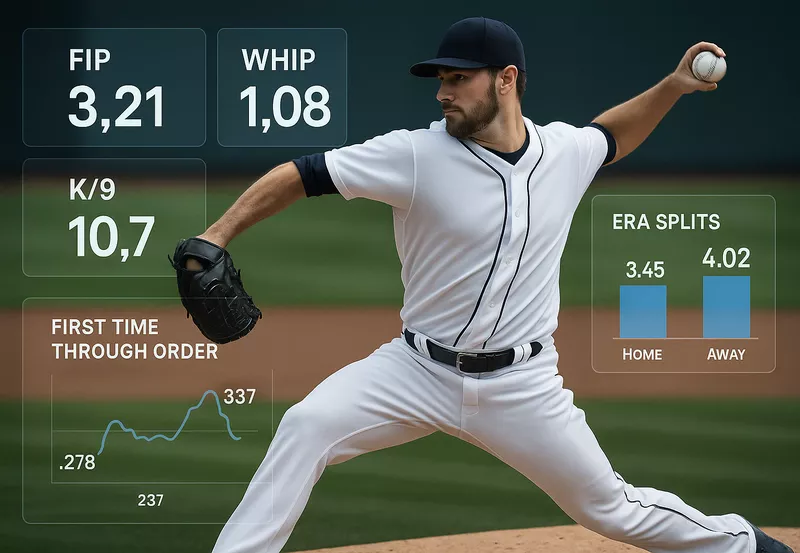
Since F5 betting essentially isolates starting pitchers, your handicapping process needs to be laser-focused on pitcher analysis. This isn’t the same as full-game pitcher analysis because you’re only concerned with roughly five to six innings of work.
First-time-through-the-order performance matters more in F5 betting than overall season stats. Some pitchers are excellent the first time they face a lineup but deteriorate badly the second and third times through. Other pitchers improve as the game progresses and they settle into rhythm. For F5 betting, you want pitchers who start strong even if they fade later.
Historical data on first-time-through-the-order can be found in advanced stats databases. A pitcher might have a 3.80 ERA for the season but a 2.90 ERA the first time through the order and a 4.80 ERA the second and third times. That’s your F5 pitcher right there. His full-game numbers look mediocre, but he’s excellent early, which is all you care about for first five innings.
Recent form over the last three or four starts is more predictive than season-long numbers. A pitcher with a 3.20 ERA on the season who’s given up five earned runs in each of his last three starts is probably dealing with something—declining velocity, tipping pitches, mechanical issues. The season-long ERA suggests he’s good. The recent form suggests he’s currently bad. Trust the recent form.
The same applies in reverse. A pitcher with a 4.50 ERA who’s thrown three straight gems with one run allowed in each might have figured something out mechanically or is benefiting from better defense or luck. Either way, his recent performance suggests he’s better than his overall numbers indicate.
Platoon splits reveal matchup advantages that casual bettors miss. Some pitchers dominate right-handed batters but get destroyed by lefties. If tonight’s opposing lineup has six left-handed batters, that pitcher’s overall stats are misleading. He might have a 3.00 ERA overall but a 4.80 ERA versus lefties. That’s crucial information for F5 betting.
Check the opposing team’s lineup—not their general roster, but tonight’s specific lineup—and compare it to the pitcher’s splits. A lineup stacked with hitters from the side that pitcher struggles against creates underdog value or makes the favorite overpriced.
Pitch count and workload expectations matter for F5 betting in ways they don’t for full-game betting. If a pitcher has thrown 105 pitches in each of his last two starts, there’s a good chance the team monitors his workload tonight and pulls him after five innings even if he’s cruising. That’s perfect for F5 betting—you’re getting his best five innings before fatigue becomes a factor.
Conversely, if a pitcher threw 75 pitches last start because the bullpen needed a break, and the team desperately needs length tonight, he might pitch through trouble in the third or fourth inning instead of getting pulled. That could hurt your F5 bet if he’s laboring.
Home versus road splits are significant for some pitchers. Certain guys are dramatically better at home—they’re comfortable in their own ballpark, they know the mound, they sleep in their own bed. Other pitchers actually perform better on the road because they’re not overthinking or dealing with home crowd pressure. These splits create edges when the market doesn’t fully price them in.
Advanced metrics predict future performance better than ERA. ERA includes defensive support and luck on balls in play. FIP—fielding independent pitching—strips those out and focuses purely on strikeouts, walks, and home runs. A pitcher with a 3.50 ERA but a 4.40 FIP is probably due for regression. A pitcher with a 4.00 ERA and a 3.00 FIP is probably better than his results suggest.
For F5 betting, xFIP and SIERA are even more predictive because they normalize home run rates and account for factors like velocity and contact quality. These advanced stats are freely available on sites like FanGraphs and Baseball Savant. Spending five minutes checking these metrics before betting F5 will dramatically improve your results.
F5 Totals Strategy
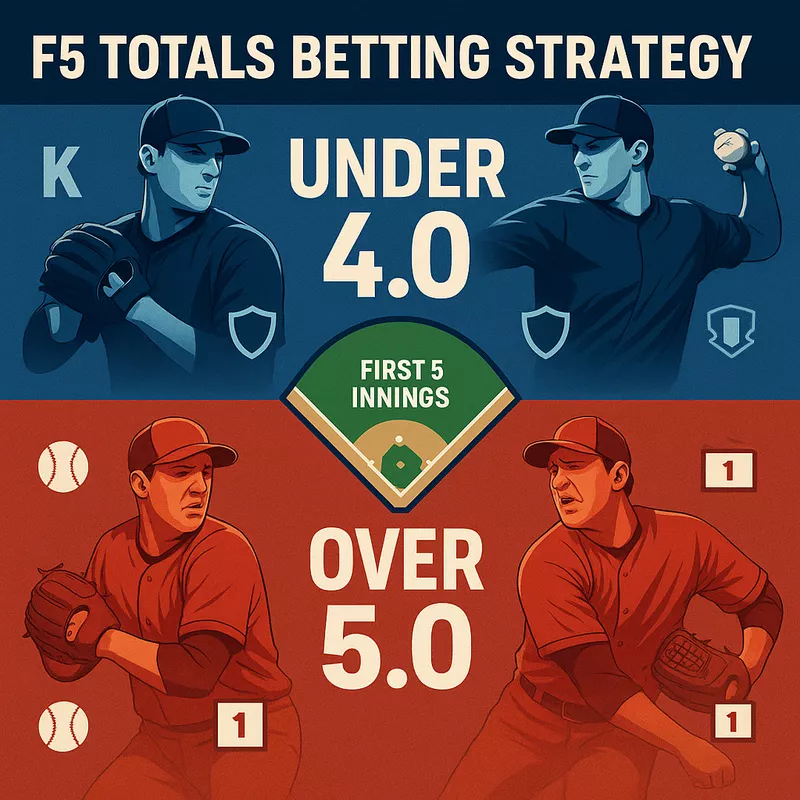
First five innings totals operate on the same principles as full-game totals but with crucial differences in how you analyze them.
The most obvious F5 totals strategy is betting unders when two aces face each other. If you’ve got a matchup between pitchers with sub-3.00 ERAs and elite strikeout rates, the F5 under is often free money. The first time through the order, these guys are nearly unhittable. The full-game total might account for eventual bullpen involvement or third-time-through-order deterioration, but F5 isolates just the dominant portion.
A typical F5 total for an ace matchup might be 3.5 or 4. That means you need four or fewer combined runs in the first five innings for the under to hit. Given that elite pitchers regularly throw five scoreless innings, this creates significant edge.
The inverse strategy is betting F5 overs when both starting pitchers are struggling. If you’ve got two guys with ERAs over 5.00 facing lineups that hit well against their pitch type, the F5 over becomes appealing. The full-game total might be set at 9.5, and the F5 total might be 5. If you believe both pitchers get shelled early, you could see three runs in the first inning alone.
Weather plays differently for F5 totals than full-game totals. Wind blowing out might not matter as much in the first five innings because the best hitters haven’t had multiple at-bats to adjust timing. Temperature matters less over five innings than nine. The F5 total is often set without fully accounting for extreme weather because oddsmakers are thinking about the full game. This creates opportunities.
Umpire strike zones affect F5 totals measurably. An umpire known for a tight strike zone helps offense because pitchers can’t work the edges. An umpire with a wide zone helps pitchers. This information is publicly available—several websites track umpire tendencies—and the F5 totals don’t always fully account for it.
Avoid F5 overs in day games after night games. Teams playing a day game immediately after a night game often see reduced offensive production in the early innings. Players are tired, timing is off, and bats are slow. The F5 total might be set the same as it would be for a standard game, but the actual scoring tends to be lower.
When Full-Game Bets Are Better Than F5
F5 betting offers significant advantages, but it’s not always the optimal choice. Certain situations favor full-game betting even when you’re primarily focused on starting pitcher matchups.
When one team has an elite bullpen facing a weak opposing bullpen, the late innings create value that F5 betting misses. If your team’s closer and setup men have ERAs under 2.50 and the opponent’s bullpen has an ERA over 5.00, those late innings should heavily favor your side. Betting the full game captures that edge. Betting F5 leaves that value on the table.
When you’re betting large underdogs, the full-game moneyline often offers better value than the F5. An underdog at plus-200 on the full game might be plus-175 on the F5. You’re giving up twenty-five cents of payout for the safety of eliminating late innings. But if you believe the underdog has a genuine chance to win, why accept worse odds? Take the full-game plus-200 and capture the entire game’s upside.
When the favorite has overwhelming offensive firepower, full-game run lines might offer better value than F5 options. A team with an elite offense often scores more runs in innings six through nine after they’ve seen the opposing starter and are facing worse relief pitching. The F5 run line might require them to be winning after five innings, but the full-game run line lets you benefit from late-inning offense.
In playoff games or critical regular season games, bullpen management changes completely. Managers use their best relievers earlier and in longer stretches. The randomness that makes F5 betting attractive in regular season games diminishes because the best arms are being deployed strategically. Full-game betting in these spots can offer better value because you’re getting everyone’s best efforts for nine full innings.
Common F5 Betting Mistakes
Even with F5 betting’s advantages, bettors find ways to lose money by repeating the same mistakes.
Betting F5 without checking starting pitcher confirmations is surprisingly common. You do your analysis Tuesday afternoon for Wednesday’s game. The listed starter has a great matchup. You bet F5 on Wednesday morning. Then you check Twitter before game time and see the team announced a pitching change. Oops. Always confirm starting pitchers within an hour of game time before your bet locks in.
Ignoring weather changes between bet placement and game time costs F5 bettors regularly. You bet an F5 over in the morning when the forecast shows seventy degrees and calm winds. By game time, the temperature dropped to fifty-five and winds are blowing in at fifteen miles per hour. That completely changes the over-under outlook. Check weather immediately before bet placement, not hours earlier.
Treating F5 totals the same as full-game totals is a conceptual error. A full-game total of 9 doesn’t mean the F5 total should be 4.5. Scoring isn’t linear across innings. The first five innings often see less scoring than innings six through nine because bullpens are generally worse than starting pitchers and hitters have adjusted to the opposing pitcher’s tendencies. The F5 total might be 4 for a game with a full-game total of 9, and that’s correct.
Betting F5 moneylines on heavy favorites without considering push probability is wasting money. A team at minus-180 on the F5 moneyline needs to be winning after five innings for you to collect. If the game is tied, you push. Roughly fifteen percent of F5 bets push. If you’re paying heavy juice on a favorite, you’re paying for win probability that includes many games where you just get your money back with no profit.
Overlooking lineup changes and rest days hurts F5 betting just as much as full-game betting. If the opposing team’s star slugger is getting a rest day, or their leadoff hitter is on the injured list, that affects early-game scoring potential. These lineup changes might be announced hours before game time. Check confirmed lineups before betting F5, not just starting pitchers.
Bankroll Management for F5 Betting
F5 betting requires slightly different bankroll considerations than full-game betting because the reduced variance creates different optimal betting strategies.
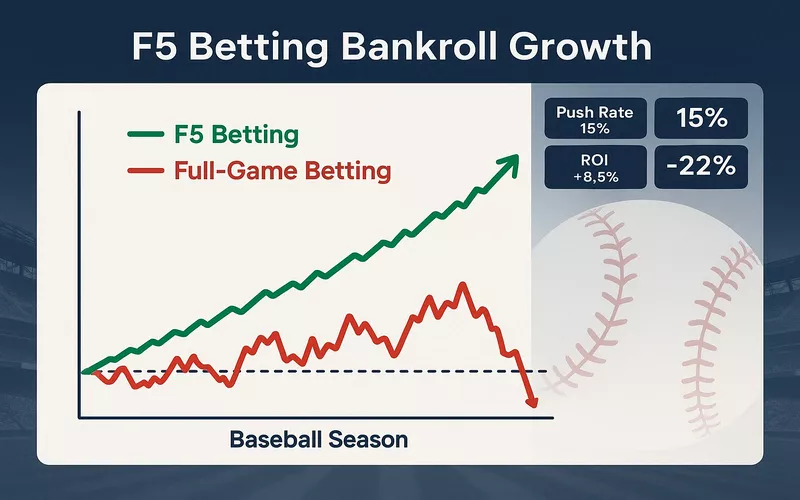
The push rate of twelve to fifteen percent means you’ll get your money back more often than in full-game betting. This effectively reduces variance because some of your losing bets become pushes instead. With lower variance, you can theoretically bet slightly larger units on F5 bets than on equivalent full-game bets.
However, this doesn’t mean betting recklessly. The standard rule of one to three percent of bankroll per bet still applies. If you’re betting F5 regularly, you might go to the higher end of that range—two to three percent “because the lower variance provides cushion. But never exceed three percent on any single F5 bet regardless of confidence level.
Track F5 betting results separately from full-game results. You might be excellent at handicapping starting pitchers but terrible at predicting full-game outcomes. Or vice versa. The only way to know is tracking each bet type independently. Use a spreadsheet with columns for date, teams, bet type, odds, result, and profit or loss.
Over time, you’ll see patterns. Maybe you’re great at F5 unders in ace matchups but terrible at F5 overs. Maybe you crush F5 underdogs but struggle with F5 favorites. This data tells you where your edge actually lives and where you’re fooling yourself.
The reduced variance of F5 betting also means your losing streaks will be slightly shorter and your winning streaks slightly longer compared to full-game betting. This creates a psychological advantage—you’ll experience fewer wild swings that tempt you to abandon your system or chase losses. The steadier equity curve makes it easier to maintain discipline.
Live Betting F5 Lines
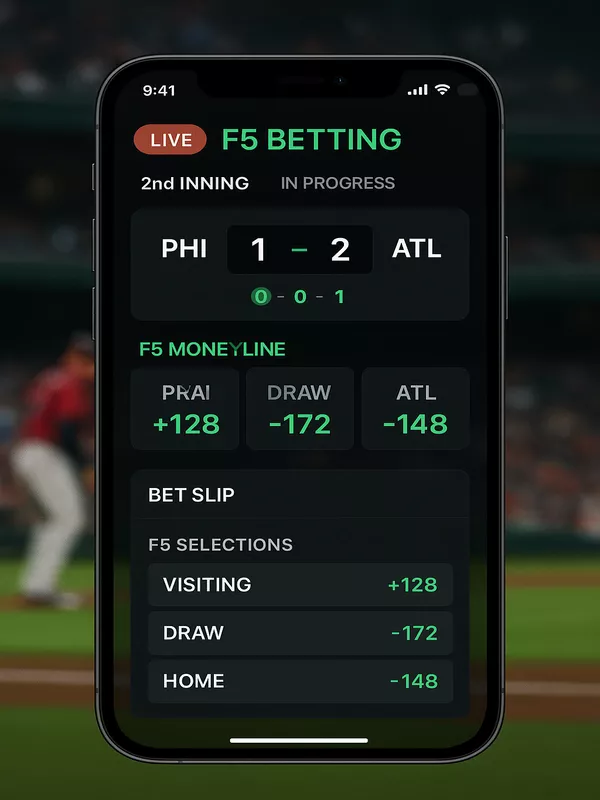
Live betting transforms F5 strategy because you can react to how the game is actually unfolding rather than predicting it in advance.
The most obvious opportunity is betting F5 underdogs after they fall behind early. If an underdog gives up two runs in the first inning, their F5 moneyline might move from plus-130 pregame to plus-250 live. If you believe the starting pitcher settles down and the offense produces, you’re getting tremendous value on a team that just needs to be tied or ahead after five innings.
The risk is that the early deficit reflects genuine problems—the pitcher doesn’t have his best stuff, or the opposing lineup has him figured out. But if the two runs scored on bloop hits and errors rather than hard contact, the live F5 line might be overreacting to bad luck.
Betting F5 unders after high-scoring first innings offers contrarian value. The first inning sees four runs scored, and suddenly the live F5 under is higher than the pregame total because the market assumes scoring will continue. But first innings are often outliers. Pitchers settle in, offenses stall, and the next four innings see minimal scoring. The live under, now inflated because of the early runs, becomes attractive.
Taking F5 overs when starting pitchers are clearly struggling is the inverse play. If both starters have thrown thirty pitches in the first inning with multiple walks and hits, they’re probably not lasting long. Even if the score is still low, the live F5 over might offer value because the impending scoring burst is obvious to anyone watching.
The challenge with live F5 betting is timing. The odds update rapidly, and by the time you notice an opportunity, the line might have already moved. You need to be watching the game in real-time and ready to act quickly. This makes live F5 betting less passive than pregame betting—you’re actively engaged with the game rather than placing a bet and walking away.
Building an F5 Betting System
Rather than betting F5 randomly or only when it feels right, develop a systematic approach to identify the best spots consistently.
Start by creating a database of starting pitcher performance in the first five innings. Track how each starter performs the first time through the order, their average runs allowed in the first five, and their win-loss-push record when you isolate F5 results. This becomes your baseline for evaluating matchups.
Identify which types of matchups produce the most F5 value for your handicapping style. Some bettors excel at finding F5 under value in ace matchups. Others crush F5 overs when both pitchers are struggling. Some find their edge in F5 underdogs while others profit from F5 favorites. The only way to discover your edge is systematically testing different approaches and tracking results.
Develop criteria for when you’ll bet F5 instead of full-game. This might be: “I bet F5 when the starting pitcher matchup is clear but I don’t trust either bullpen” or “I bet F5 unders when two pitchers with sub-3.20 FIPs face each other” or “I bet F5 on any underdog where the starting pitcher is actually better than the favorite’s starter despite the overall team quality difference.”
Whatever your criteria, make them explicit and follow them consistently. This prevents the trap of retroactively justifying bets based on results. If your system says bet F5, you bet F5. If it says pass, you pass. No exceptions based on hunches or feelings.
Review your results monthly. Are you winning on F5 moneylines but losing on F5 run lines? Are F5 unders more profitable than overs? Do road favorites on F5 perform better than home favorites? This ongoing analysis refines your system and helps you focus on the specific F5 bet types where you have genuine edge.
First five innings betting fundamentally changes how you approach baseball because it forces you to focus on the parts of the game you can actually predict. Starting pitchers are knowable. Bullpens are chaos. By betting only on the predictable portion, you’re tilting the odds in your favor in ways that full-game betting doesn’t allow.
The strategic advantages—isolating starting pitchers, avoiding bullpen randomness, eliminating extra innings, capturing lineup stability—compound into a betting approach that’s simply more consistent and less vulnerable to bad luck than traditional full-game wagering. This is why sharp professional bettors have quietly made F5 betting their preferred method while recreational money continues flowing into full-game markets.
But F5 betting isn’t a magic solution that prints money automatically. You still need to handicap starting pitchers properly, understand matchup dynamics, track weather and lineup changes, and avoid the common mistakes that trap casual bettors. The advantages of F5 betting create opportunities, but only if you’re doing the analytical work to identify them.
Whether you’re betting F5 moneylines, run lines, or totals, the core principle remains the same: focus on what you can predict and eliminate what you can’t. The first five innings are predictable. The last four aren’t. Bet accordingly, track your results rigorously, and let the reduced variance work in your favor over hundreds of bets across a long baseball season.
